
On Piano Journal
The Emotional Power of Cinematic Piano Music
How instrumental music creates images, memories, and places within us.
Why can instrumental music move us without saying a single word?
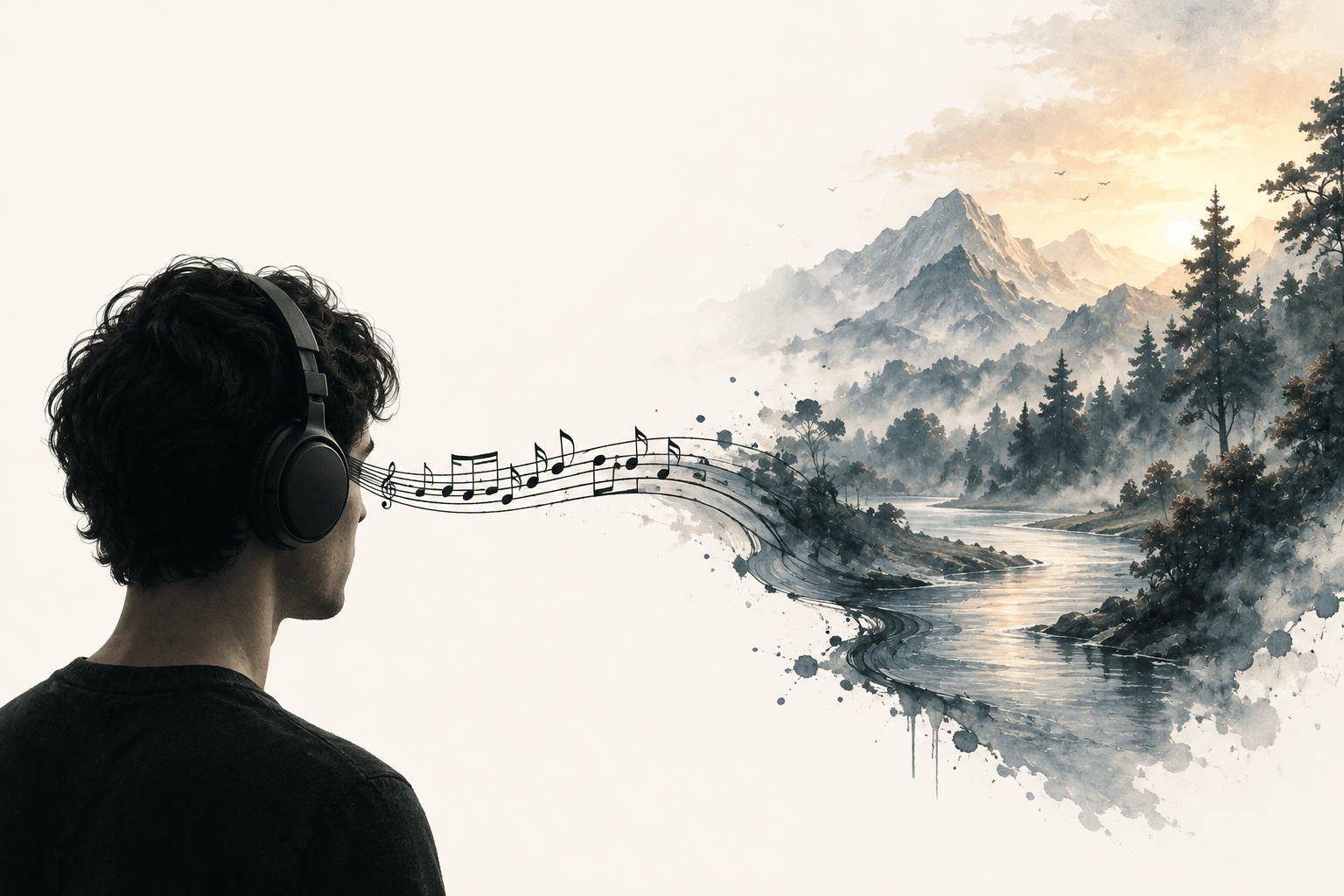
Have you ever listened to a piano piece and, without realizing it, found yourself somewhere else?
Maybe you were looking out of a train window, walking through a forest, or remembering someone you hadn't thought about in years.
The strange thing is... none of those images were actually in the music.
No lyrics.
No narrator.
No explanation.
Just a melody.
And yet, your mind quietly filled in the rest.
This is one of the most fascinating things about instrumental music. It doesn't describe the world around us. It invites us to discover the world within us.
Why the Piano Feels So Human
Among all instruments, the piano teaches us something unusual: every note begins its journey toward silence.
From the very moment a key is pressed, the sound is already changing. It doesn't fight against time or try to remain the same. It simply follows its natural course.
Perhaps that's why the piano feels so honest. It reminds us that some of life's most meaningful moments aren't meant to last forever.
The piano can whisper with the lightest touch or fill an entire concert hall with remarkable power. Few instruments can move so naturally between fragility and strength, between intimacy and grandeur.
That extraordinary range allows it to express almost every shade of human emotion: vulnerability, hope, longing, serenity, joy, and quiet sorrow.
Perhaps that's why the piano has become such a natural voice for cinematic music.
It doesn't ask us to imagine something specific.
Instead, it leaves space for imagination.
And within that space, sound quietly becomes images, memories, and emotions that belong to each listener alone.
Every note begins its journey toward silence.
Every Listener Creates a Different Film
Play the same piano piece for ten different people, and you'll hear ten different stories.
One sees the ocean.
Another, a snowy mountain.
Someone else remembers a face they haven't thought about in years.
The music hasn't changed.
The listener has.
That's one of the quiet gifts of instrumental music.
When a song has lyrics, the story is already taking shape. We know who is speaking, what happened, and often how we're meant to feel.
Instrumental music works differently.
It offers no characters.
No dialogue.
No plot.
Instead, it leaves space for the listener to complete the picture.
Every memory, every landscape, every emotion comes from a different life. That's why no two people experience the same piece in exactly the same way.
Perhaps that's what makes cinematic piano music so deeply personal.
It never asks us to enter someone else's story.
It quietly becomes our own.
Silence Is Part of the Music
When we think about music, we usually think about notes.
But composers know that some of the most important moments happen between them.
A pause isn't simply a moment when nothing happens. It's what gives a melody time to breathe. Without silence, one note would simply follow the next, leaving little room for emotion to settle.
Silence creates contrast. It builds anticipation. It allows every phrase to have shape and meaning.
A melody doesn't end with its last note. It ends when the listener has finished feeling it.
That's why silence is never empty.
It's the moment when music slowly becomes memory.
When Music Becomes a Place
Not every piece of music tells a story.
Some pieces become a place.
Not a place you can find on a map, but one you recognize the moment you hear it. A place where time slows down, memories surface more gently, and emotions have a little more room to breathe.
That's one of the quiet strengths of cinematic piano music. Rather than describing a specific event, it creates an atmosphere that each listener experiences differently.
Some compositions feel like a journey.
Others feel like a state of mind.
For example, Along the River by On Piano feels like a journey inward. Like the steady flow of a river, it invites the listener to keep moving, even without knowing exactly where the current will lead. It reminds us that not every journey is about reaching a destination. Sometimes, simply continuing forward is enough.
Another piece by On Piano, Drifting Away , explores a very different emotional landscape. Rather than taking the listener on a journey, it captures the quiet uncertainty of drifting into the unknown. Familiar landmarks disappear, certainty slowly fades, and all that remains is the hope that somewhere beyond the horizon, land still exists.
Featured Pieces
 Along the River
A quiet journey inward.
Listen
Along the River
A quiet journey inward.
Listen
 Drifting Away
An exploration of solitude, uncertainty,
and the hope of finding land.
Listen
Drifting Away
An exploration of solitude, uncertainty,
and the hope of finding land.
Listen
Perhaps that's why instrumental music never feels confined to a single moment.
It doesn't ask every listener to experience the same emotions.
Instead, it quietly creates a place where each of us can discover our own emotions and memories.
Some places are created by music.
Long after the final note has faded, we can still find our way back to them.
Conclusion
Every piece of instrumental music begins the same way.
With a few simple notes.
What happens next no longer belongs entirely to the composer.
It belongs to the person listening.
A melody may awaken a forgotten memory, bring back a familiar place, or simply offer a few quiet moments in an otherwise busy day. The music remains the same, yet every listening experience is unique.
Perhaps that's why instrumental music continues to find a place in every generation.
It doesn't ask us to explain it.
It simply asks us to experience it.
And maybe that's enough.